On Bank Holiday Monday a swan landed on the Headford road near Carrowbrown. The Gardai asked me to help. A passing motorist stopped and took it off the road. Unfortunately, it had been hit by one or two cars. It was badly bruised. I took the poor thing with me. Some pain relief was administered. I was afraid of internal injuries and bleeding. The swan took a turn for the worse next day and died peacefully.
Wednesday, March 21, 2012
Swans in trouble.
At this time of year many swans are on the move. Some are searching for territories of their own. Others are trying to attract mates! Many land in unfriendly places where they are attacked by resident swans. Others land on wet roads mistaking them for rivers. Some land in small gardens or yards and cannot leave as there isn't sufficient length for a take off. We have received several calls from all over the country seeking advice. We got calls from Camus and Carraroe in Connemara, from Dublin city and county, Cork city, Ennis, Co. Clare and all over the county.

Monday, June 20, 2011
More Cygnets!
Once again I am rearing three cygnets! This little brood was abandoned by it's parents ( an unusual occurrence ) They may have been intimidated by other swans. At only one day old they were being washed down the Corrib. We were called by a fisherman who noticed their plight. Feargal donned his wetsuit and with much difficulty in the deep and strong current he found four. We found the parents and tried to coax them to take the cygnets back,but to no avail.
They are now four weeks old and three of them made it. They are off the heat lamp and are thriving on a diet of duck and geese pellets and large amounts of shredded lettuce. Lucy, the goose is caring for them. They are enjoying their baths in the paddling pool under Lucy's close supervision!
They are now four weeks old and three of them made it. They are off the heat lamp and are thriving on a diet of duck and geese pellets and large amounts of shredded lettuce. Lucy, the goose is caring for them. They are enjoying their baths in the paddling pool under Lucy's close supervision!
Friday, June 11, 2010
Swan Sanctuary for Galway
Galway and Claddagh Swan Rescue are delighted to announce that Galway City Council have given us permission to erect a holding pen beside the 'Swan Sanctuary' container in Lough Rusheen Park, Barna.
We are in the process of applying for Planning Permission. We also have to have an appropiate Environmental Impact study carried out. The company, Aqua Fact, in Liosbaun is doing this for us free of charge! This is very generous of them. We really appreciate it.
This pen will be used to house swans, ducks and other wetland birds while they are recovering from injury and for the rearing of orphaned birds.
We have to fund this project ourselves. We are hoping that volunteers will do the work and that we may get the materials at a good price!
Maybe some generous persons out there would wish to become 'PATRONS'
We would appreciate DONATIONS!
Our Bank Account is Galway & Claddagh Swan Rescue, A.I.B.Salthill, Galway.
Account Number 03161-039
Sort Code 93-74-01
PLEASE HELP US TO COMPLETE THIS PROJECT
For further information phone Mary on 086 8155361
We are in the process of applying for Planning Permission. We also have to have an appropiate Environmental Impact study carried out. The company, Aqua Fact, in Liosbaun is doing this for us free of charge! This is very generous of them. We really appreciate it.
This pen will be used to house swans, ducks and other wetland birds while they are recovering from injury and for the rearing of orphaned birds.
We have to fund this project ourselves. We are hoping that volunteers will do the work and that we may get the materials at a good price!
Maybe some generous persons out there would wish to become 'PATRONS'
We would appreciate DONATIONS!
Our Bank Account is Galway & Claddagh Swan Rescue, A.I.B.Salthill, Galway.
Account Number 03161-039
Sort Code 93-74-01
PLEASE HELP US TO COMPLETE THIS PROJECT
For further information phone Mary on 086 8155361
Friday, October 23, 2009
The Cygnets are growing up!


During the month of July the cygnets got much bigger. Their soft down was starting to change into stubby feathers.

I also gave them the run of my back garden when the new fence was erected.


By now they were enjoying their swims and games in the paddling pool.
The cygnets were happy to share the garden, the pool and the pen with injured ducks that were recovering and a few clutches of ducklings!
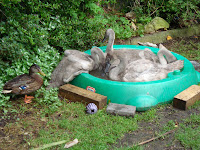


Each evening they were put into the secure pen so that they would be safe from predators overnight.
By the middle of August they were fully feathered and growing rapidly.
By the middle of August they were fully feathered and growing rapidly.

Their appetites were growing also. They enjoyed larger amounts of poultry pellets in water in a much larger trough. This they ate enthusiastically morning and evening. In the middle of the day they consumed large amounts of shredded lettuce, cabbage and carrots. For the greens I must thank Joyce's Supermarket, Knocknacarra, Galway. The staff there were very generous to the cygnets and were very interested in their progress.

As September wore on I knew the cygnets were ready for release. Before I let them go I weighed each one. The heaviest one was 8.8kg. and the lightest of the four was 6.5kg. Didn't they do well?
We released the four of them at 2.30pm. on Saturday 3rd. October, 2009 in the Claddagh at the mouth of the river Corrib. They were so happy to have lots of water space! I hoped they would be safe. Immediately they swam away and explored the area. I had many anxious moments that evening and during the next two days trying to locate them. After that they settled in the Claddagh. We are still supplementing their feeding a little. I am glad to report that 3 weeks later they continue to make great progress. The other swans and cygnets have accepted them fully.
Many wellwishers came to watch the release and take photographs.
We released the four of them at 2.30pm. on Saturday 3rd. October, 2009 in the Claddagh at the mouth of the river Corrib. They were so happy to have lots of water space! I hoped they would be safe. Immediately they swam away and explored the area. I had many anxious moments that evening and during the next two days trying to locate them. After that they settled in the Claddagh. We are still supplementing their feeding a little. I am glad to report that 3 weeks later they continue to make great progress. The other swans and cygnets have accepted them fully.
Many wellwishers came to watch the release and take photographs.
Friday, October 9, 2009
Rescued Cygnets
A clutch of cygnets were seen in distress and without parents close to Spanish Arch. They were being taken out to sea by the current. A member of the public rescued them from the water. Galway & Claddagh Swan Rescue was contacted. Imelda took them home and kept them warm under an infra-red lamp. Meanwhile another lone cygnet was rescued from the canal. All this happened during the June Bank Holiday weekend.

The first clutch were only a few days old. The lone cygnet was about 3 weeks old.
I took them home to Knocknacarra. The four cygnets were very comfortable together under the infra-red lamp. It was not long until they got the 'hang' of eating chick pellets soaked in water. They formed a family group. It was lovely to see the oldest one looking after the three little ones!

After 2 weeks they were ready to live in a pen in my back garden. They enjoyed the space and the paddling pool. By then they were eating very well and growing rapidly. At this stage they need lots of green vegetables in their diet. I want to thank Joyce's Supermarket, Knocknacarra, for supplying copious amounts of lettuces, cabbage and carrots, which I had to shred for them every day!
Monday, June 22, 2009
Homing Pigeons

You may come across a Homing Pigeon ( sometimes called a Carrier pigeon ) in your garden. You will recognise it as it will have rings on both legs. The letters I.H.U. will be on them. Sometimes these birds get lost or blown off course by strong winds. They may be exhausted or dehydrated. The best one can do for them is to provide clean water, bird seed, porridge oats or any grain and a safe place, away from cats, for them to rest up for a couple of days. Usually, they can make their own way home after that.


On the Irish Homing Pigeon website you will be able to find the names of local contacts in your county.
Saturday, May 16, 2009
Gulls are Hatching

Throughout the Summer months gull chicks will be hatching all over the city and in coastal areas. In the city gull parents choose tall buildings for their nest sites. They particularly like flat roofs on which to rear their noisy brood.
 When the chicks are ready to fledge (leave the nest) they jump and flutter down on to pavements , alleys, car parks, gardens etc. As they are unable to fly at this stage the parents feed and guard them, often dive-bombing anyone who interferes. It can take up to two weeks for the flight feathers to develop.The gull chicks are almost as big as the adults. Their feathers are brown and speckled. The chicks should never be removed, as the parents are feeding them, unless they are on the street. If they must be moved to a safer place it should be very close by so that the parents can see them.
Many fledglings stay on the ground for a period of time after they leave the nest as their flight feathers are not developed. These include rooks, hooded crows, jackdaws, magpies, mistle thrushes, pigeons and many more. Their parents feed them, guard them and teach them to fly.
Please do not remove any of these birds in the mistaken belief that they are injured. They need the protection and example of their families so as to survive in the wild.
Thursday, May 7, 2009
Rearing Mallard Ducklings
 A clutch of mallard ducklings should never be taken away unless one is certain that mother duck has abandoned them. She may have been frightened off or she could be feeding nearby. When we are called to help we put them into a deep box with a hot water bottle wrapped in a towel. The box should be covered with a heavy towel. This keeps stress to a minimum on the journey. As soon as we are home they are put in a large duckling box on a bed of hay and an infra red lamp hanging overhead to keep them warm.
A shallow dish of water and a dish of chick crumbs with finely mashed hardboiled egg and water added are left with them. Each duckling must be made aware of the food and water several times in the next few hours. They will soon get the hang of feeding. Finely crushed egg shell must be added to the food regularly to prevent calcium deficiency. The heat lamp must be left on 24 hours a day for up to 3 weeks. In the fourth week it can be turned off during the day.
At this time they can be introduced to a covered in outdoor pen in the day time. A large, shallow container of water, about 10 to 12cm. deep should be left in the pen and changed regularly. They will enjoy it and it is not too deep for them to drown! Ducklings that are reared by hand are not waterproof and will drown in deeper water. By getting wet they are encouraged to preen and this stimulates their oil glands to produce an oily wax. This will waterproof their feathers gradually.

From two weeks onwards they need green matter in their diet also. Chopped lettuce or broccoli in water is suitable.
Ducklings have many enemies when there is no mother duck to protect and train them. These include, drakes, gulls, magpies, hooded crows, cats, mink etc. Handling by humans should be kept to a minimum while they are being reared as they must be kept wild if they are to be released successfully. When their flight feathers are fully developed, at 8 to 9 weeks, they can be released in a pond where there is plenty of water weeds, insects and cover. Fast flowing water is not suitable as they will be washed away and separated.
A lone duckling would have a poor chance of survival. When this happens a friend of ours, who has free range hens and ducks, takes the duckling into his flock. Some time later, when the 'call of the wild' comes, the duckling will fly away!

Mallard ducks are described as ' dabbling ducks' as they are often seen feeding on the bottom of shallow ponds and estuaries with their tails in the air.

The adult drake is beautifully coloured, with a shiny green head, orange legs and feet and curls on his tail! In contrast the duck is mostly a dull brown colour.

Monday, April 27, 2009
Mallard duck and ducklings

When a duck is taking her ducklings to water (within one day of hatching) she sometimes chooses an unsuitable route! Last week a duck and her 8 ducklings were strolling through Eyre Square Shopping Centre! One of the managers called our emergency number and Imelda,one of our volunteers, went in and caught them with the help of four staff members.
In such rescues it is very important to catch mother duck first to insure she does not fly away. Without her they would have to be handreared. Having her protection is much better.
We relocated mother and ducklings to a lovely clean lake, with plenty of food and cover, in Ardrahan. They have been seen a few times since and are doing very well!
Saturday, April 25, 2009
Mallard Ducklings
Mallard ducklings are being hatched all over the city and county. The duck builds her nest in very inaccessible places so as to protect the eggs from predators. She can lay a large number of eggs, sometimes between 12 and 15. When all the eggs are laid incubation begins. This can take 14 to 18 days. In the first 24 hours after hatching mother duck must take her ducklings to water to feed.
This is a very dangerous time for them. Magpies, gulls or crows may prey on them. It is not uncommon to see a duck trying to cross a busy road with her clutch in tow ! They often fall into holes, drains and cattle grids are a great hazard. They cannot get out of these and have to be rescued. The best help one can give them is to allow them to cross in safety and not to handle the ducklings unless absolutely necessary. It is very important that mother duck is not frightened off. If this happens the ducklings will have to be handreared. This is a long and difficult process. The best one to rear them is mother duck.
Friday, March 20, 2009
Easter Eggs

Eggs are a sign of new life and joy. Swans, ducks and all wetland birds are busily building their nests and preparing to lay their eggs. Swans nest in the reeds around lakes, ponds and rivers. As their eggs are large, the incubation period is between 35 and 39 days. Incubation begins when all the eggs are laid. They can lay between 5 and12 eggs. Ducks and smaller wetland birds incubate between 14 and 20 days.
Monday, March 9, 2009
Wednesday, March 4, 2009
Our Team Officers.
Chairperson: Ruth Quinn.
V.Chairperson: Des O' Dowd.
Secretary: Suzanne Divilly.
Treasurer: Mary Joyce-Glynn.
Hon. Member: Imelda O Brien.
Fund Raiser: Breda Lenihan.
Our Emergency Phone Number,086 3826471
is displayed on the window of the Claddagh Hall.
The G.S.P.C.A. , The Gardai in the city and county and surroundings counties, Galway City Co., Galway County Co., Dept. of Agriculture and Veterinary Clinics have the phone number.
Chairperson: Ruth Quinn.
V.Chairperson: Des O' Dowd.
Secretary: Suzanne Divilly.
Treasurer: Mary Joyce-Glynn.
Hon. Member: Imelda O Brien.
Fund Raiser: Breda Lenihan.
Our Emergency Phone Number,086 3826471
is displayed on the window of the Claddagh Hall.
The G.S.P.C.A. , The Gardai in the city and county and surroundings counties, Galway City Co., Galway County Co., Dept. of Agriculture and Veterinary Clinics have the phone number.
Wednesday, February 25, 2009
Accidents

The most common cause of serious accidents to swans is flying into overhead power lines. Swans usually fly in the morning and evening when the glare does not allow them to see the lines in time. Their weight prevents them from turning in time. These accidents are usually fatal or if they survive they are often paralysed. We have had reports of such accidents happening in the Maree, Oranmore area, Abbeyknockmoy, Dunmore, Portumna, Headford and Gort areas. Both Mute swans and the migratory Whooper swans have been involved in these accidents.
Thursday, February 12, 2009

Galway & Claddagh Swan Rescue is appealing to the public to exercise extreme care when parking and driving away in the vicinity of the Claddagh Hall and Claddagh Quay. Swans lie beside the cars and do not get up when an engine starts. Since September 2008 nine swans have been driven over and killed and a few more were so badly injured they had to be euthanaised.
The emergency phone number is 086 3826471
I can also be contacted on 086 8155361
The emergency phone number is 086 3826471
I can also be contacted on 086 8155361
Tuesday, November 4, 2008
Migration

Flocks of Whooper Swans have arrived from Iceland to spend the Winter months grazing and feeding on turloughs and grasslands. They have been seen at Rahasane in Craughwell.
Tuesday, October 28, 2008
Galway & Claddagh Swan Rescue.

Galway & Claddagh Swan Rescue is in operation for more than seven years. We are a small voluntary group based in Galway City. We are involved in the protection and conservation of all wetland birds, indigenous and migratory. We rescue and treat injured and weak birds. It is great to release a healthy bird back into it's own territory.
We do call outs around the city and county. We also do rescues in surrounding counties. We are called by members of the public, the Gardaí, G.S.P.C.A, Sports Grounds and Golf Clubs. A lot of our work involves giving advice over the phone. We get calls seeking advice from all over the country as we appear to be the only voluntary group providing this service for the city, county and the people of Ireland.
Subscribe to:
Posts (Atom)